Martial Arts, Qigong, and Shen 神 (Spiritual) Cultivation
Master Zhongxian Wu
" I. Introduction
At the 2003 National Qigong
Association conference in Asheville, North Carolina, I was asked about
the difference between martial arts and Qigong. The querying
practitioner followed both of these practices and pointed out that they
appear to be such different disciplines that their respective intentions
must also differ. The practitioner wanted to know how I reconciled
this seeming discrepancy.
I was able to answer my
colleague only briefly. Based upon my training and experience there is
no true difference. Although at first glance, Qigong and martial arts
may appear to be separate entities, at a deeper level of practice, they
are really the same– especially with respect to use for healing and
spiritual cultivation. Due to the shortness of time, I was not able to
provide greater detail in my answer.
At the same conference, I met with Frances Gander, editor of the Journal of Martial Arts and Healing.
She invited me to write an article for this magazine. I view this
article as an opportunity to provide a more in-depth answer about the
relationship between Qigong and martial arts.
II. Martial Arts: The Way of Not Fighting
The common understanding of martial arts is that it is the art of attack and defense, or Gong Fu – in other words, a mere fighting skill. However, at its most profound level, it is the art of not
fighting; in fact, it really means a method to stop fighting. To help
us understand this, we can briefly analyze the Chinese term for martial
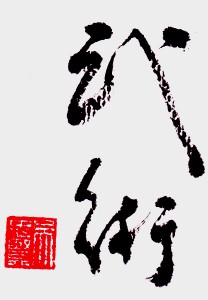
arts – Wu Shu 武术 (see Figure 1):
Wu is commonly
translated as “martial.” The character is constructed of two radicals:
one means stop and the other means weapon. The original meaning of Wu is “to stop fighting.” Shu means an art, technique, or method. In other words, Wu Shu really means the art or technique of not fighting at all.
The most skilled martial artists not only find it unnecessary to kill, but will also stop others from fighting.
[i]
Martial arts were created and perfected long ago; they are modeled
after patterns of basic life. The prehistoric Chinese lived in
accordance with nature, hunting for their livelihood and even sometimes
fighting for their lives. For this life, it was necessary for them to
understand their intentions, potential, and of course their own bodies.
These people also had to understand their enemies — their strengths,
their techniques, and the means by which they might best be controlled.
On the other hand, ancient China was beset by wars between the varied
states and tribes. Living in such conditions compelled these people to
create training techniques for self-defense and sometimes for attack.
The sages or the great
shamans who lived during this time also created movement to help others
understand the Universal Way. They discovered that the virtue (function)
of Heaven is to protect and preserve all life and to give birth to the
ten thousand tings, so the spiritual goal of the martial artist is to
follow the Heavenly way, the way of peace. These movements were intended
to bring people closer to the Dao because martial arts could be used to
save a life or bring peace in war. (This sort of war, let us remember,
was only waged to help maintain the greater peace.
There are possibly hundreds
of martial arts schools in China: large schools such as the well-known
Shaolin, Wudang, and Emei schools, and smaller schools that teach a
particular family’s style or form. Different masters have their own
training styles and techniques. Regardless of this, at the very deepest
level all schools work with the Shen or spirit. At their highest degrees, all of them emphasize cultivation of the Shen in order to connect with the Universal Way.
How to cultivate the Shen?
How might one reach this highest level? Engaging in this level of
practice is no different from the highest levels of Qigong practice.
Let us examine how the concepts of Qigong can help us fathom the deeper
knowledge of martial arts.
III. Qigong
Qigong is a traditional method of physical, mental, and spiritual cultivation.
Qi is usually translated into English as “vital energy.” The existence of the universal
Qi
is like a musical rhythm. Even if we can’t see it, we can feel it in
our bodies and in the environment through a deep heart/mind connection.
Classical Chinese culture is a
Qi culture.
[ii] According to classical Chinese philosophy,
Qi is the most basic and important material in the universe.
Qi is
the original energy of the universe and follows the laws of the cosmos
as it cycles between tangible and intangible forms. Guanzi管子 (d.645
B.C.E.) described the Qi in his
Neiye 内業 (Inward Training) as below.
Speaking of the vital essence of beings
This what gives them vitality.
It generates the five grains below;
It becomes the arrayed stars above.
When flowing between the heavens and the earth,
We refer to it as ghostly and spiritual.
When stored within the human chest,We call such beings sages.
[iii]
Qigong is a practice for cultivating knowledge and a main method for moving into Tian Ren He Yi 天人合一 (the state of oneness of the universe and the human being). Qigong is translated into English as “Qi cultivation” or “to work with the Qi.” There are many forms of Qigong
practice: sitting meditation, breath work, regulation of mental focus
and emotions, visualizations, mudras, mantras and movement — including
Taijiquan and other martial arts. Qigong facilitates the development of a deeper relationship with Qi. This relationship helps the practitioner understand the laws of the universe and how they influence human life.
With the basic concepts of Qi and Qigong, we may find it easier to understand the way of spiritual cultivation in martial arts.
IV. De 德 (Virtue) — The Way of Entering into Study
The tradition of martial
arts or Qigong training can also help us understand the original
principle of martial arts and Qigong. Entering into traditional study
with a master is like joining a family. The Chinese saying Shi Fu Ling Jing Men – “upon entering through the door and into the family, one needs guidance from the master.
Those desiring to study
request the master to accept them. Once the master agrees, a deep
relationship grows between the two. This system is quite different from
today’s school system where one merely pays to attend classes. This is
illustrated by the saying Yi Ri Wei shi, Zhong Sheng Wei Fu –
“One day with my master is like an entire lifetime with my father.” This
traditional relationship is similar to a family lineage. The words
“school” of martial arts, Qigong, or other classical Chinese arts, in
Chinese, are called “men 门 (gate)”– the gate of a family. In other
words, a school is like a family in traditional Chinese way.
When new students come to the master, the first lesson usually is Wu De. De
means virtue – to study the real virtue of the martial artist. A
martial arts lesson is not merely a lesson in techniques for defense or
attack. De is the way to connect with the traditional (lineage) Qi field
and to learn the deeper knowledge. A Wu De education starts with the first lesson and continues for an entire lifetime of training.
Martial arts training is the same as training in traditional Qigong. In Qigong this is called Gong De: the virtue of a real Qigong master. Gong De is also used in Chinese to mean a person who always helps others. As a result of this compassion, students build up their own Gong De. A person without Gong De can never be a real master. This De
or virtue goes hand in hand with compassion. Such virtue and
compassion are absolute necessities in the context of the power of
martial arts. Therefore, a true master – of either Qigong or the
martial arts – refrains from passing along all his or her knowledge
at one time. Special techniques of the lineage are not taught to just
anyone. A deserving student must be truly dedicated, possess compassion
and integrity, and have the ability to follow the Dao. In very ancient
times, even basic techniques were reserved for those who were specially
chosen.
The knowledge of the
lineage comes not from just the master but from the master’s masters –
from the ancient sages. This venerable knowledge was meant to be passed
down to worthy individuals. Disciples who respect the Dao and the way
of Nature will uphold the reputation of the lineage rather than use its
techniques for immoral acts or personal gain.
The Chinese say Bu Chuan Fei Ren,
or don’t teach the person unless he or she is the right one. One who
has learned secret techniques but who has a bad heart can bring great
harm to the community. My own master forbade me from teaching certain
secret lineage techniques unless I could be certain a student possesses
the highest virtue. Shi Fu Zhao Tu Di – the master finds the
disciple. In other words, the highest level teaching occurs when the
master finds the student rather than vice versa. Again, this is true in
both martial arts and Qigong.
Ti Tian Xing Dao 替天行道is another affirmation used to remind the martial artist of his or herultimate purpose. Ti Tian, which literally means, “replace heaven,” meaning to do the universal way. Xing means to carry out. Ti Tian Xing Dao means that “the Dao is transferred on behalf of the heavens.”
V. The Three Levels of Training
As a reflection of the layers that construct the Universe – Tian (Heaven), Di (Earth), and Ren (Human being)– traditional training in both Qigong and martial arts has three levels.
Martial arts training involves a process of strengthening the Yi, Qi, and Li: Yi is the mind, will, and spirit; Qi is the vital energy; Li is the inner force. Yi, Qi, and Li are like the Three Treasures: Jing is Li, Qi is itself, and Shen is Yi. Human beings are made of these three substances (Jing, Qi, and Shen),
which in English may be called as Essence, Vital Energy, and Spirit
respectively. These Three Treasures are viewed in Daoism as the highest
form of medicine for human beings.
Jing is linked to the Kidney and symbolizes Yin energy and Earth. It is material and therefore easy to see.
Qi is the vitality
that results from the transformation of energy between Heaven and
Earth. Qi also symbolizes the physical and Qi bodies of human beings.
Usually, Qi is more felt than seen. When it is seen, it looks like a
vapor or gas, or with practice, it can been seen in different colors.
Shen is linked to
the heart and symbolizes Yang energy and Heaven. It is spiritual energy
and invisible. The (Daoist) immortals are equated with Heaven; the Shen
is the immortal aspect of the body
These three layers are connected: Qi may
be transformed into Jing and into Shen. Qi is also the energy used to
drive this process. The cultivation of Qigong practice links all of
these layers.
The terms Yi, Qi, and Li
illustrate the same concepts. Once a person starts training in a
particular martial arts technique, he or shealways works with these same
Three Treasures.
There are different schools
in Qigong and martial arts, so to the beginner, the training may appear
different superficially. But the purpose is the same: in the martial
arts, before one can develop a good ability to attack, defend, or
maintain the peace, he or she first needs a strong physical body.
The First Level: Jing or the Healing Function
From the very beginning of training, the
physical body changes and becomes stronger. Some patients can recover
from disease by going through such training. When one practices Qigong
and wants to move to the highest level of cultivation, he or sheshould
have a healthy body. If one gets sick, he or she cannot sit or stand to
do spiritual cultivation. Thus, the first part of Qigong involves the
physical body and building health to withstand the rigors of
cultivation.
To illustrate the importance of cultivating the body or
Jing / healing function, let us use the story of Huo Yuan Jia (1868-1909), a martial artist of the late Qing Dynasty.
[iv]
Huo Yuan Jia was born in
the village of Xiao Nan He near the western border of Tianjin. His
father was a renowned boxer who passed his skills on to his sons when he
retired. The family was famous for its martial arts lineage. In their
village, there lived another family also renowned for martial skills.
Every year the two families would hold a competition to display their
prowess.
But Huo Yuan Jia was the
runt of the family and was often bullied by his playmates. The father
was ashamed of this weakness and feared Huo Yuan Jia would disgrace the
entire family in boxing contests. The old man thus forbade him from
learning the family’s Wu Shu techniques.
This hurt Huo Yuan Jia’s
pride greatly and made him determined to prove himself to his father and
everyone else. It was this determination that strengthened his Shen and gave him the wherewithal to change his physical body.
Unbeknownst to his father,
Huo Yuan Jia secretly observed his father teaching the other family
members. In addition, the child attended the other family’s training
sessions. This other family also disregarded him as a weakling and a
youngster, and they never worried about Huo Yuan Jia.
Thus Huo Yuan Jia was able
to observe undisturbed. While alone at night he would practice
techniques from both families. In this way, he developed into a
strapping young adult.
One year at the annual
competition, an old man jumped into the fighting circle and easily beat
both families. No one could beat this unknown old man, and he was
declared the champion. As he was about to leave, however, Huo Yuan Jia
jumped into the circle and easily beat the stranger – much to the
surprise of both families. Today, Huo Yuan Jia is one of the most
famous martial artists in Chinese history.
This story inspired me when
I was young and realized that a weak body could be transformed to be
strong through martial arts practice. The importance is that one should
understand the healing function of martial arts –changing the mind. Huo
Yuan Jia may never changed his heath condition and became the famous
martial artist if he just followed his father’s idea – martial art is
the parctice for heathy and strong people.
Thus, martial arts are not
just for those with great physical strength. Even so, one need not
engage in war to understand how to use once own medicine – Jing, Qi, and
Shen to change the physical body through enough practice. The keystone
of this practice is correct posture.
Correct posture is a model
of life. With the right posture, one can easily win a battle and resist
sickness. This is because the Qi is able to circulate and flow without
stagnation. Healing is a direct result of this circulation. When his
or her energy is strong a martial artist or Qigong master can transmit
his or her energy to help the patient. This process is no different
from the healing aspect of Qigong.
The Second Level: Qi
At the middle level of
martial arts training, one’s intention is shifted from strengthening the
body to developing techniques of defense and attack. It is important to
learn how to follow the Dao and to work through one’s opponent. For
this, the practitioner must engage in a higher level of Shen (mind and spirit) cultivation. This helps one to understand his or her own body and also the opponents’ bodies.
This middle state of Qigong training focuses on strengthening the Jing and transforming it to Qi, and strengthening the Qi to nourish the Shen. The practitioner learns to work with and release disease by using the vital energy to release pathogenic factors.
This process is akin to
entering into a battle at the Qi level. The disease is regarded the
same as one regards a martial arts opponent. Qigong and martial arts
processes have the same intent: to focus on the Qi state and understand
the flow of Qi. Through this, we will understand more deeply how to
release evil influences or how to stop fighting.
In China, there are many
martial artists who are also Qigong masters and healers. They use the
same abilities to assist patients as they do in defense and attack.
When treating patients, they use the same intention as when facing an
opponent.
The Highest Level: Shen
The highest level of practice for any martial artist is to avoid fighting and killing. The Xici 系辞 (the Appended Statements) of the Book of Changes (Yi Jing, also commonly called the I Ching) states, “Shen Wu Bu Sha”
(Fig.2) – the highest level martial artist does not act through killing
or fighting. The highest level martial artist is adept at controlling
conditions so the other side accedes and killing or fighting becomes
unnecessary. (Shen is usually translated as spirit; it also means perfect. Shen Wu means the perfect martial artist – one who acts without fighting or killing.)
How to reach this level? The
Art of War [v]
states, “Know the enemy and know yourself; in a hundred battles, you
will never be defeated.” From this point, we can understand that the
best way for a warrior or a martial artist in competition is not only
skill in a technique or method but also a deeper level of wisdom.
This exhibits a true understanding of the Universal Way and is called the Wu Dao: the way of martial arts. In both Qigong and martial arts, the highest focus is Tian Ren He Yi, or returning to the Dao and to the Universal Truth.
A real understanding of the
Dao or way of the martial arts would lead to the use of these skills as
a healing art. The same training can be used for quite different
results. From the Shen or spiritual perspective, martial arts may be considered a type of Qigong.
VI. Conclusion
It may seem that there is
no significance in discussing the application of classical martial arts
strategies in war, even in today’s front line combat. However, it would
bring great peace if world leadership could learn the wisdom and follow
the guidance of ancient global strategy. If a war has to happen, it
would, at the very least, reduce the killing. The Art of War illustrates this principle: “To subdue the enemy without fighting is the supreme excellence.”
The
Ji Xiao Xin Shu[vi]
(New Book of the [Army or Martial] Discipline Method) by Qie Ji Guang
details wartime preparations using armies skilled in martial arts. That
is to say, this book discusses using martial arts in the context of a
large coordinated group. Most critical is the concept of
Ji Wei,
which means (1) very small, subtle things, (2) the way of the Heart,
and (3) the Law of the Universe or Nature. This was the method used by
the Yellow Emperor to guide his army in uniting all of China.
Rather than merely discoursing on combat techniques, Qie Ji Guang underscores the importance of this Ji Wei
root. He points out that King Wu used compassion to direct his army.
In this way, he won a great war and replaced the Shang Dynasty by
establishing the Zhou Dynasty. From this we may learn that true martial
arts stem from the Heart, which is the origin of compassion and the
Universal Way (Dao).
It’s the same as Qigong and Shen
(spiritual) cultivation. With wisdom and compassion, a practitioner of
martial of arts, may learn to cultivate a kind of reverence for life.
Thus,) even the defense and attack techniques could be healing
techniques. Such study, technically and philosophically, does indeed
harmonize the body, mind, and spirit and bring great benefits for the
entire world around us..."
http://abodetao.com/martial-arts-qigong-and-shen-%E7%A5%9E-spiritual-cultivation/




 and
and  . These can also simply be called the "two forces,"
 (where ch'i,
  , the "Book of Changes."
 Yin originally meant "shady, secret, dark, mysterious, cold." It thus could mean the shaded, north side of a mountain or the shaded, south bank of a river.
  Yang in turn meant "clear, bright, the sun, heat," the opposite of yin and so the lit, south side of a mountain or the lit, north bank of a river. From these basic opposites, a complete system of opposites was elaborated. Yin represents everything about the world that is dark, hidden, passive, receptive, yielding, cool, soft, and feminine. Yang represents everything about the world that is illuminated, evident, active, aggressive, controlling, hot, hard, and masculine. Everything in the world can be identified with either yin or yang. Earth is the ultimate yin object. Heaven is the ultimate yang object. Of the two basic Chinese "Ways," Confucianism is identified with the yang aspect, Taoism with the yin aspect.
 The familiar diagram of Yin and Yang, the
  , the "Great Ultimate" [Wade-Giles T'ai-chi] diagram, shows the opposites flowing into each other. The diagram also illustrates, with interior dots, the idea that each force contains the seed of the other, so that they do not merely replace each other but actually become each other. (The earliest attested example of the diagram, strangely enough, occurs on a Roman shield illustrated in the fifth century Notitia Dignitatum.)
 , and No Mind,
  , are practiced, then the Tao guides change in a natural, easy way, making for beauty and life. Since trying to be in control is a yang (or Confucian) attribute, Taoism sees Not Doing (and Taoism itself) on the yin side of things; but since Not Doing does not literally mean doing nothing, Taoism can use the language of passivity and receptivity to mean something that is actually quite active.
 [Wade-Giles jou2], "soft, pliant, yielding, gentle." Róudào, the "yielding way," is read in Japanese as judô and is the name of a popular Martial Art. Judo doesn't look at all yielding or gentle, but it does employ Taoist doctrine in so far as it is not supposed to originate force or an attack but takes the attack of an opponent and uses its own force against it.
 When it comes to the five elements, earth, water, and wood are clearly to be associated with yin. Water, the softest and most yielding element, becomes the supreme symbol of yin and the Tao in the Tao Te Ching. Fire (the hottest element) and metal (the hardest) both are associated with yang.

 , that symbolizes wood is a principal symbol of
 , that symbolizes metal is a principal symbol of
  , representing yin, and an unbroken line,
  , representing yang. During the Shang Dynasty (1523-1028 BC), questions that could be answered with a "yes" or a "no" were written on tortoise shells. The shells were heated, then doused in water, which caused them to crack. A broken crack,

 ), i.e. the determination of the auspicious or inauspicious situation and orientation of places (cities, temples, houses, or graves). Chinese cities are properly laid out as squares, with gates in the middle of the sides facing due north, east, south, and west. The diagonal directions are then regarded as special "spirit" gates: northwest is the Heaven Gate; southwest the Earth Gate; southeast the Man Gate; and northeast the Demon Gate. The northeast was thus the direction from which malevolent supernatural influences might particularly be expected. The situation of the old Japanese capital city of Kyôto is particularly fortunate.
  To the northeast is a conspicuous, twin-peaked mountain, Mt. Hiei (corresponding to the Mountain trigram), which is crowned with a vast establishment of Buddhist temples to guard the Demon Gate. Later, Tôkyô (originally called Edo) was laid out with temples to the northeast on rising ground in the Ueno district; but both the ground and the temples are now entirely surrounded and obscured by the sprawl of Tôkyô. [note]
 , with the Lake,
  . A lake is essentially a valley filed with water (both with Yin associations), and the mountain in general may be also contrasted with the valley,
  . We see this contrast in related characters, such as
  , "an immortal," and
  , "common, vulgar, worldly." Each of these contains the "mountain" and "valley" characters, respectively, with the radical for "person,"
  . The idea seems to be that immortal beings live in the mountains, either because that is where the divine belong (as on Mt. Olympus) or because that it where Taoist adepts, who achieve immortality, practice their asceticism. Thus,Taoists themselves can be called
  , the "immortal-ists" or "school of the immortals." What is down in the valley is then common, mundane, and vulgar.
 of them into 64 hexagrams. The hexagrams represent states of affairs, and the I Ching is consulted through the construction of a hexagram to answer one's question. The construction is carried out either through a complicated process of throwing and counting yarrow stalks, or by throwing three coins. The obverse (head) of each coin is worth 3 points (odd numbers are yang), while the reverse (tail) is worth 2 (even numbers are yin). Three coins will therefore add up to either 6, 7, 8, or 9. The numbers 7 and 8 represent "young" yang and yin, respectively. Starting from the bottom up, these add a plain yang,
 The "old" lines therefore change into their opposites, giving us two hexagrams if any changing lines are involved: the first hexagram, representing the current state of affairs; and the second hexagram, after the changes have been made, representing the future state of affairs. Changing lines are usually denoted by writing
  for a 9 and
  for a 6. The text of the I Ching describes the significance of each hexagram and also the special meaning to be attached to the presence of any changing lines.
